
dirty meat and shot placement

TR Treeman 2 years ago

I am tired of dirty meat, cutting away blood meat, then washing and more cutting to get the half digested grass out of wherever it's been blown into.
Cody and I are meat hunters, so full on shoulder shots are really not an option. We have tried double lung shots, through one shoulder in and out behind far side shoulder, behind one in and out on far side in shoulder. We have tried full frontal and we tried in behind last rib and out on far side shoulder, shot placement we have tried in excess - much.
Everytime its either blood meat or gut content in the wound channel or surrounds, and it sucks to work such an carcass. The clients are now told "in on the shoulder bone and out on or behind other side shoulder" - sorry about the meat loss.
I do a lot of headshots, but they are almost entirely on those get lucky at 80 m here pops a head out looking other direction cases - freehand shooting. Lovely clean carcass and no meat damage.

I have been talking to Cody about taking lower neck shots, in front of the shoulder from the side and above the line of the spine if from front or back. The frontal or facing away shots are pretty safe, if you hit the neck its dead, the side on shots I am still pondering.
Tonight we again looked at a carcass we were working and discussed the matter in detail, what shots to take and where to put the bullet.

Who here shoots neck shots ? Tell me about neck shots.
0
[deleted]

Agree, body shots are bloody and wasteful even though they are surer and easier. A neck shot - in my little experience with them - can be just as bloody and gooey as a shoulder shot. However, the bloody area and wasted meat is much less, and the larger cuts of meat are clean.

I have not taken many neck shots, but they are usually slightly easier than a head shot, simply because the neck does not move so much and the target area is slightly bigger.

In the upper neck area, they go down to stay down. It must have something to do with the shock to the medula oblongata.

In the upper neck area, they go down to stay down. It must have something to do with the shock to the medula oblongata.

I wonder if it might have something to do with a pressure wave in the blood so close to the brain?

In the upper neck area, they go down to stay down. It must have something to do with the shock to the medula oblongata.

I wonder if it might have something to do with a pressure wave in the blood so close to the brain?

************************************
no ! - It is simply the destruction of the spine, central nervous system.
Only 2 + 1 ways to kill.
Damage to nerve system
Loss of blood
Destruction of a vital organ, but that is by the result of one of the 2 above mentioned.

Everybody proposes head shots for clean meat. Lately I have shot three impala with neck shots just below the head. There is only 1 cm of meat on either side of the vertebrae and is a safe shot. It also looks neater than a head shot animal with eyes popping out. The easiest is with the animal looking away as the nose and teeth are out of the way.

In the upper neck area, they go down to stay down. It must have something to do with the shock to the medula oblongata.

I wonder if it might have something to do with a pressure wave in the blood so close to the brain?

************************************
no ! - It is simply the destruction of the spine, central nervous system.
Only 2 + 1 ways to kill.
Damage to nerve system
Loss of blood
Destruction of a vital organ, but that is by the result of one of the 2 above mentioned.

I was meaning where the spine hasn't been destroyed. Mate of mine does harvesting, sometimes from helicopters and has shot dozens of animals a day on occasion. He shoots head and neck shots exclusively to spare meat and says that he's had bokkies drop where the spine has not been severed. I'm talking here about shots that are within centimetres of the brain but have hit neither it nor the spine.

I wonder if it might have something to do with a pressure wave in the blood so close to the brain?

************************************
no ! - It is simply the destruction of the spine, central nervous system.
Only 2 + 1 ways to kill.
Damage to nerve system
Loss of blood
Destruction of a vital organ, but that is by the result of one of the 2 above mentioned.

I was meaning where the spine hasn't been destroyed. Mate of mine does harvesting, sometimes from helicopters and has shot dozens of animals a day on occasion. He shoots head and neck shots exclusively to spare meat and says that he's had bokkies drop where the spine has not been severed. I'm talking here about shots that are within centimetres of the brain but have hit neither it nor the spine.

****************************
if he is doing neck shots from a heli, they use shotguns, shotguns multiple wounds disrupt the nervous system causing death. That said, I think a supersonic bullet passing a cm from the spine will still cause severe terminal damage to the system - shutdown.

There is only 1 cm of meat on either side of the vertebrae and is a safe shot. It also looks neater than a head shot animal with eyes popping out. The easiest is with the animal looking away as the nose and teeth are out of the way.

********************************
Yes, this is my chosen "head shot" that you describe, I seldom aim at the head itself - usually the head from behind through neck. If you hit, its down and over and if you miss its a total miss.

The shot I am wanting to explore is the low neck front of shoulders, for those longer shots.

if he is doing neck shots from a heli, they use shotguns, shotguns multiple wounds disrupt the nervous system causing death. That said, I think a supersonic bullet passing a cm from the spine will still cause severe terminal damage to the system - shutdown.

The choppers aren't what they use most of the time but when they do he shoots a stubby barrelled lightweight savage bolt action in 6.5 creed of all things.

if he is doing neck shots from a heli, they use shotguns, shotguns multiple wounds disrupt the nervous system causing death. That said, I think a supersonic bullet passing a cm from the spine will still cause severe terminal damage to the system - shutdown.

The choppers aren't what they use most of the time but when they do he shoots a stubby barrelled lightweight savage bolt action in 6.5 creed of all things.

***************************
:o Yoh !!!!!!!!!!!!!!!!!!!!! man must be quite able with a rifle.

One problem that I can foresee is that if you miss the spine, the shock to the CNS from a bullet hitting close to the CNS is enough for the animal to drop on the spot. Then you go up to it to cut the throat etc, and it suddenly gets up and runs away because it was just stunned, and not killed. I have seen this happen a few times on animals where a bullet comes close but doesn't damage the CNS.

Then again, to stir a bit with Treeman ;D :

1. a 270 win is fast and therefor terrible with respect to meat damage it causes.
2. lead cup and core bullets kill the best, but are the worst for meat damage
3. point 1&2 and synergistic ;)

1. a 270 win is fast and therefor terrible with respect to meat damage it causes.
2. lead cup and core bullets kill the best, but are the worst for meat damage
3. point 1&2 and synergistic ;)

******************************
I think almost any bullet, if it hits that last part of the neck would be a killer. There is just so "no nothing" else in that small space, just dead if touched stuff.
Add a cup and core bullet and its even deader.

I agree, for anything CNS a fast frangible bullet works best. You might miss the brain or spinal chord, but there are often enough small bullet fragments to go astray, and do the necessary.

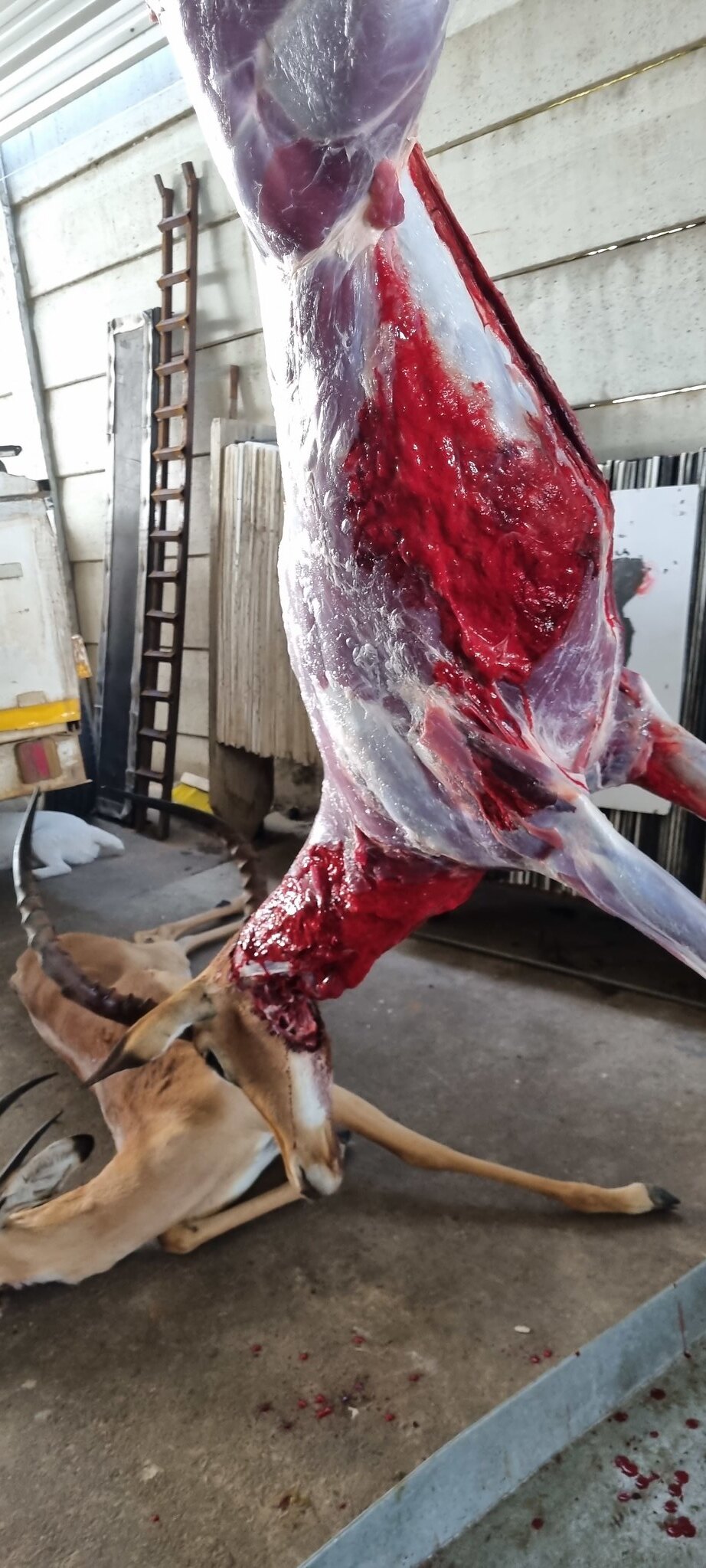
Guys, I have a problem ! This 7mm08 of Cody's is just causing so much meat damage - I just can not work it out.
Animal is Impala - fallow deer
7 mm Hornady Interlock 154 gr
velocity 5 m = 2650 fps
average shot distance 80 -130 m
meat damage 30 cm every direction from hole - yet we are often recovering reasonably well held together mushroomed bullets,its not like they splattered or impact was like 3000 fps - my .270 is fairing better meat damage wize.
What is going on here.
20231216_104248 by David Frank Allen, on Flickr
20230717_205227 by David Frank Allen, on Flickr

[deleted]

I have had the same with 308, 180gr @ 2400fps.

What is going on here.

What's the weight of that bullet? Looks like its shed quite a bit? Possibly a bonded version going forward?

BUT WHY< WHY IS THIS HAPPENING<

[deleted]

I contacted a PH friend. He said that it has occurred often when animals were calm and not aware of the hunters.

Another probable explanation would be something related to blood pressure.

And it could be a combination of both.

Did that animal drop quickly or did it run some distance after the shot?

From what I have seen with hunters who come here to shoot, it occurs more often when they hit both lungs, but the animal runs a fair distance before expiring. The theory is that the punctured lungs forces a lot of blood out the new hole and into the surrounding tissue. I have seen this irrespective of the calibre used. It is just a little more pronounced with faster bullets.

To me that looks like the animal ran a lot before it passed out from blood loss. The running pulls blood into the damaged connective tissue.

There are 2 different processes that involve meat damage:

1) Damage to the tissue immediately around the path of the bullet hole characterized by dark red meat a few cm around the bullet hole. This is made worse the faster the bullet is traveling due to shock. This is worse with lead bullets that fragment and the lead particles spread through the muscle tissue. This also is bad when you strike bone, and the bone fragments have the same effect as lead fragments. The cause of the colour change is fragmentation of capillary network of the surrounding tissue, causing a blood infiltrate. Since the capillaries in the tissue are small, the extent of the blood flow is limited. Less pronounced with mono&#039;s unless you hit bone.

2) Tissue infiltrate, which is what I see in the picture, where the animal is bleeding from engine room damage (hint: major vessels) and there is a path open between the source of the blood and the network of connective tissue that is found in the facia between the muscle layers. As the animal runs away, the movement between the layers pulls the blood in, and is a b1tch to get rid of. When you cut through, the meat (muscle) is clean and free of the above (point 1). Can happen with both monos and cup and core and severity is associated with the time the animal takes to die and the amount the animal moves after being shot.

Did that animal drop quickly or did it run some distance after the shot?

From what I have seen with hunters who come here to shoot, it occurs more often when they hit both lungs, but the animal runs a fair distance before expiring. The theory is that the punctured lungs forces a lot of blood out the new hole and into the surrounding tissue. I have seen this irrespective of the calibre used. It is just a little more pronounced with faster bullets.

**************************************************
20 m max before falling, usually on the spot.
BUT !
The bigger question is why is it so pronounced this rifle combination ?

To me that looks like the animal ran a lot before it passed out from blood loss. The running pulls blood into the damaged connective tissue.

There are 2 different processes that involve meat damage:

1) Damage to the tissue immediately around the path of the bullet hole characterized by dark red meat a few cm around the bullet hole. This is made worse the faster the bullet is traveling due to shock. This is worse with lead bullets that fragment and the lead particles spread through the muscle tissue. This also is bad when you strike bone, and the bone fragments have the same effect as lead fragments. The cause of the colour change is fragmentation of capillary network of the surrounding tissue, causing a blood infiltrate. Since the capillaries in the tissue are small, the extent of the blood flow is limited. Less pronounced with mono&#039;s unless you hit bone.

2) Tissue infiltrate, which is what I see in the picture, where the animal is bleeding from engine room damage (hint: major vessels) and there is a path open between the source of the blood and the network of connective tissue that is found in the facia between the muscle layers. As the animal runs away, the movement between the layers pulls the blood in, and is a b1tch to get rid of. When you cut through, the meat (muscle) is clean and free of the above (point 1). Can happen with both monos and cup and core and severity is associated with the time the animal takes to die and the amount the animal moves after being shot.

***********************************
No ! - this is a lot of jello, spread far between muscles.

The Hornady Interlock bullets are not very hard and deform very quickly. This might explain the blood under the skin on entry.

[deleted]

When blood from the chest cavity bleeds into the area around the wound, it usually leaves a thick, dark, gooey clump of blood. In some cases I have cleaned it, and the meat was still edible.

The haemorrhage in the photo looks and works differently - it is usually lighter blood, and it penetrates the slimey tissue between the skin and the muscles, as well as the muscles themselves. Trying to clean this is really tough because everything is gooey.

When blood from the chest cavity bleeds into the area around the wound, it usually leaves a thick, dark, gooey clump of blood. In some cases I have cleaned it, and the meat was still edible.

The haemorrhage in the photo looks and works differently - it is usually lighter blood, and it penetrates the slimey tissue between the skin and the muscles, as well as the muscles themselves. Trying to clean this is really tough because everything is gooey.

*********************************
KORECKTEEEEEEEE O !!!!!!!!!!!!!!!!!!!!!!!!! Very messy, we are now just cutting 4 - 5 kg out and dumping, just not worth anything else.

[deleted]

Food for thought/suggestion: dark (used) blood causes dark, gooey clumps, maybe because it flows slower. Light (arterial) blood causes large, slimey haemorrhages because it is under higher pressure.

???

Further question: does this occur mainly/mostly on one side of the animal (related to anatomy), or on both sides - bullet-related?

Food for thought/suggestion: dark (used) blood causes dark, gooey clumps, maybe because it flows slower. Light (arterial) blood causes large, slimey haemorrhages because it is under higher pressure.
???
Further question: does this occur mainly/mostly on one side of the animal (related to anatomy), or on both sides - bullet-related?

*********************************
Both side and sideways and in out every where - just this rifle and bullet - its this bullet, I am convinced of this.

[deleted]

Do you have access to an x-ray machine? Maybe at a vet? It would show lead fragments.

Quite an explosive round - ELDX

Do you have access to an x-ray machine? Maybe at a vet? It would show lead fragments.

I saw a yoochoob vid some time back when lead bullets were being banned by the companies in the UK that buy game meat from recreational hunters and professional harvesters. Their xrays of lead bullet shot animals were interesting as they showed quite substantial intrusion and dispersion of lead into the meat even where there was no obvious visual cues of it. The commercial buyers banned lead projectiles in their supply chain long before the government got to it.

[deleted]

If it is due to the bullet, it should be controllable with other types of bullets.

Sierra makes their Gameking in 150gr and 160gr.

Question: can someone say what happens whit mono bullets?